Biodiversity Net Gain (BNG) changed for smaller development sites in England on 6 August 2026

For developers, strategic land teams, landowners and planning professionals, the headline change is a new area-based exemption: mandatory BNG no longer applies to planning applications where the development site within the red line boundary is 0.2 hectares or below, provided the development does not negatively affect on-site priority habitat.
But site area alone does not determine the BNG position.
Three development sites of exactly the same size could have very different ecological baselines – and therefore very different BNG, planning and commercial implications.
For sites that remain subject to mandatory BNG, the baseline can influence development capacity, layout, biodiversity-unit requirements, viability and the balance between on-site and off-site delivery.
For development and strategic land teams, the key point is therefore:
Same site area, different ecological baseline – and potentially very different development ramifications.
What changed for smaller development sites on 6 August 2026?
The Government introduced a series of changes to mandatory BNG in England on 6 August 2026 following its consultation on minor, medium and brownfield development.
The changes most relevant to smaller development sites include:
- a new exemption for development sites of 0.2 hectares or below, subject to safeguards for on-site priority habitat;
- a revised biodiversity gain hierarchy for qualifying minor development, allowing on-site and registered off-site gains to be considered at the same stage;
- a new exemption for qualifying temporary development lasting five years or less; and
- removal of the previous self-build and custom-build exemption for new planning applications.
The existing de minimis exemption also remains in place.
The Government's current guidance on developments exempt from mandatory BNG sets out the exemptions and relevant conditions.
These reforms change the BNG position for some smaller developments, but they do not remove the importance of understanding what is present on a site.
Where mandatory BNG continues to apply, development must achieve at least a 10% increase in biodiversity value.
What counts as a small or medium development for BNG?
The terminology around small, minor and medium development can be confusing because they are not all separate statutory BNG categories.
What is a small or minor development?
Current Government BNG guidance uses “small” and “minor” development together.
A small or minor development is one that does not fall within the definition of major development under the Town and Country Planning (Development Management Procedure) (England) Order 2015.
For BNG purposes, Government guidance describes small development as including:
- residential development of between one and nine dwellings on a site of one hectare or less, or, where dwelling numbers are not known, a site of less than 0.5ha;
- commercial development creating less than 1,000m² of floorspace or with a total site area below one hectare; and
- development that is not minerals or waste development.
Importantly, minor development is not automatically exempt from BNG.
A minor development above 0.2ha may still be subject to mandatory BNG unless another exemption applies.
What is a medium development?
“Medium development” is not currently a separate statutory BNG category with its own mandatory BNG rules.
The term has been used in Government consultation and wider planning discussions, but describing a development as medium-sized does not by itself determine:
- whether BNG applies;
- whether an exemption is available;
- whether the Small Sites Metric can be used; or
- whether the revised minor-development gain hierarchy applies.
This distinction is particularly important when appraising commercial, mixed-use or other development where residential unit thresholds may have little relevance.
The appropriate approach is to establish the planning category, determine whether an exemption applies and understand the ecological baseline of the site.
The new 0.2ha BNG exemption explained
From 6 August 2026, mandatory BNG does not apply to planning applications where the site area within the red line boundary is 0.2 hectares or below.
That means a development site of exactly 0.2ha falls within the area threshold.
However, there is an important safeguard.
Where the development would negatively affect on-site priority habitat, the exemption cannot be used.
This is why the size of the site only answers the first question. What is actually present on the land can determine whether the exemption is available.
Three 0.2ha development sites: same area, different ramifications
Consider three hypothetical development sites.
Each has exactly the same red line area: 0.2 hectares.
Their likely BNG positions could nevertheless be very different.
Scenario 1: 0.2ha site with no vegetation or negligible habitat
The first site is dominated by sealed hardstanding, with no on-site priority habitat negatively affected by the proposed development.
Likely BNG position: the new area-based exemption would normally apply, meaning mandatory BNG would not be required.
For the development team, that could remove the requirement to undertake the statutory BNG metric process and provide the mandatory 10% gain.
However, exemption from statutory BNG does not necessarily mean BNG does not need to be addressed, as local BNG planning policy as well as wider ecological considerations also need to be considered.
Depending on the site and proposal, protected species, nesting birds, trees, designated sites or other ecological receptors may still need to be considered through the planning process.
The appropriate response should therefore remain proportionate to the site and proposed development.
Scenario 2: 0.2ha site with apparently low-value vegetation
Now consider a second 0.2ha site containing grassland, scrub or other vegetation that appears to be of relatively low ecological value.
No priority habitat is known to be affected.
Likely BNG position: the area-based exemption may still apply.
The important word is may.
Low-value vegetation should not automatically be assumed to have little biodiversity value based on appearance alone.
Where there is uncertainty, a proportionate baseline habitat assessment can help establish:
- which habitats are present;
- whether priority habitat could be affected;
- whether the area-based exemption can be relied upon;
- whether other ecological constraints are present; and
- whether ecology could influence the emerging design or programme.
For developers and strategic land teams, the value of early ecological advice is not about adding unnecessary assessment. It is about making development and planning decisions using robust assumptions.
Scenario 3: 0.2ha site containing priority habitat
The third development site has the same 0.2ha red line area, but the proposal would negatively affect on-site priority habitat.
BNG position: the new area-based exemption does not apply.
Assuming no other exemption is available, mandatory BNG would need to be addressed.
That could influence:
- the development footprint and layout;
- habitat retention;
- development capacity;
- biodiversity-unit requirements;
- on-site habitat provision;
- the need for registered off-site biodiversity units;
- BNG costs and viability; and
- long-term habitat delivery.
For a strategic land team, these findings could influence land appraisal or masterplanning well before a planning application is prepared.
For other developments, they could affect decisions around floorspace, infrastructure, access, drainage, landscaping or the developable area.
The distinction is therefore important:
0.2ha tells you whether the area-based exemption may be available. It does not tell you the ecological baseline.
How is the 0.2ha exemption different from the de minimis exemption?
The area-based exemption and de minimis exemption are separate tests.
The area-based exemption considers the size of the entire development site within the red line boundary. The relevant threshold is 0.2ha or below.
The de minimis exemption instead focuses on how much habitat is affected by development.
Under the de minimis rule, mandatory BNG does not apply where development impacts less than:
- 25m² of on-site habitat with biodiversity value; and
- 5 metres of on-site linear habitat, such as hedgerow.
The de minimis exemption cannot be used where priority habitat is impacted.
A development site larger than 0.2ha could therefore potentially qualify for de minimis where the actual habitat impact is sufficiently limited.
In simple terms:
Area-based exemption = how large is the development site?
De minimis exemption = how much habitat is affected?
This distinction can be particularly relevant for small schemes on larger sites, changes of use and developments where physical works have very limited effects on existing habitat.
Why the ecological baseline can affect development capacity and viability
Where mandatory BNG applies, the statutory biodiversity metric measures the existing biodiversity value of the site and compares this with the proposed post-development position.
Habitat type, area, condition and other ecological characteristics can therefore affect the biodiversity units generated by the calculation.
This means BNG is not simply an ecology calculation to complete once the design has been fixed.
The baseline can influence:
- developable area;
- layout and density;
- floorspace or development capacity;
- access and infrastructure;
- drainage and green infrastructure;
- habitat retention;
- on-site habitat creation;
- off-site biodiversity-unit requirements;
- BNG costs and viability; and
- long-term habitat management.
Early and repeated use of the statutory metric can help project teams compare different layouts and BNG strategies. Government guidance itself highlights early and repeated use of the metric as a way to assess existing biodiversity value and compare on-site and off-site proposals.
For example, if one part of a site supports higher-value habitat while another supports lower-value habitat, adjusting the development footprint may reduce biodiversity-unit losses.
That could reduce the amount of habitat creation, enhancement or off-site compensation required.
For strategic land appraisal and promotion, this information can be particularly useful while genuine choices about development location, capacity and masterplanning remain available.
More flexibility for minor development: on-site or off-site BNG?
Another significant change from 6 August affects the biodiversity gain hierarchy for qualifying minor development.
For development generally, BNG can be achieved through:
- on-site habitat creation or enhancement;
- registered off-site biodiversity gains; and
- Government statutory biodiversity credits as a last resort.
For qualifying minor development subject to mandatory BNG, on-site and registered off-site gains can now be considered at the same stage. Developers can choose to deliver BNG off-site without considering on-site delivery first.
The Government's guidance on Biodiversity Net Gain provides further information on these delivery options and the revised hierarchy for minor development.
This change could be particularly useful for constrained sites.
Why strategic land teams should consider BNG early
For strategic land, BNG should not be treated solely as a calculation completed during the planning application process.
The greatest opportunity to manage its implications is often during site appraisal, promotion, feasibility and masterplanning.
Early ecological and BNG assessments can help identify:
- where higher-value habitats occur;
- which parts of a site may be more appropriate for development;
- where habitat retention could reduce biodiversity-unit losses;
- how BNG could affect development capacity;
- likely on-site habitat requirements;
- potential demand for off-site units;
- likely BNG costs;
- opportunities across wider landholdings; and
- whether the emerging masterplan provides a realistic basis for long-term habitat delivery.
That information can be relevant when setting assumptions around land value and viability.
A site that initially appears capable of supporting a particular level of development may look different once its ecological baseline is understood.
Conversely, early ecological input may identify alternative layouts or delivery strategies before planning, design and commercial assumptions become difficult to change.
For larger landowners, there may also be opportunities to assess whether other parts of a landholding could support registered off-site habitat creation, subject to ecological suitability and the relevant statutory requirements.
BNG also means thinking about long-term habitat delivery
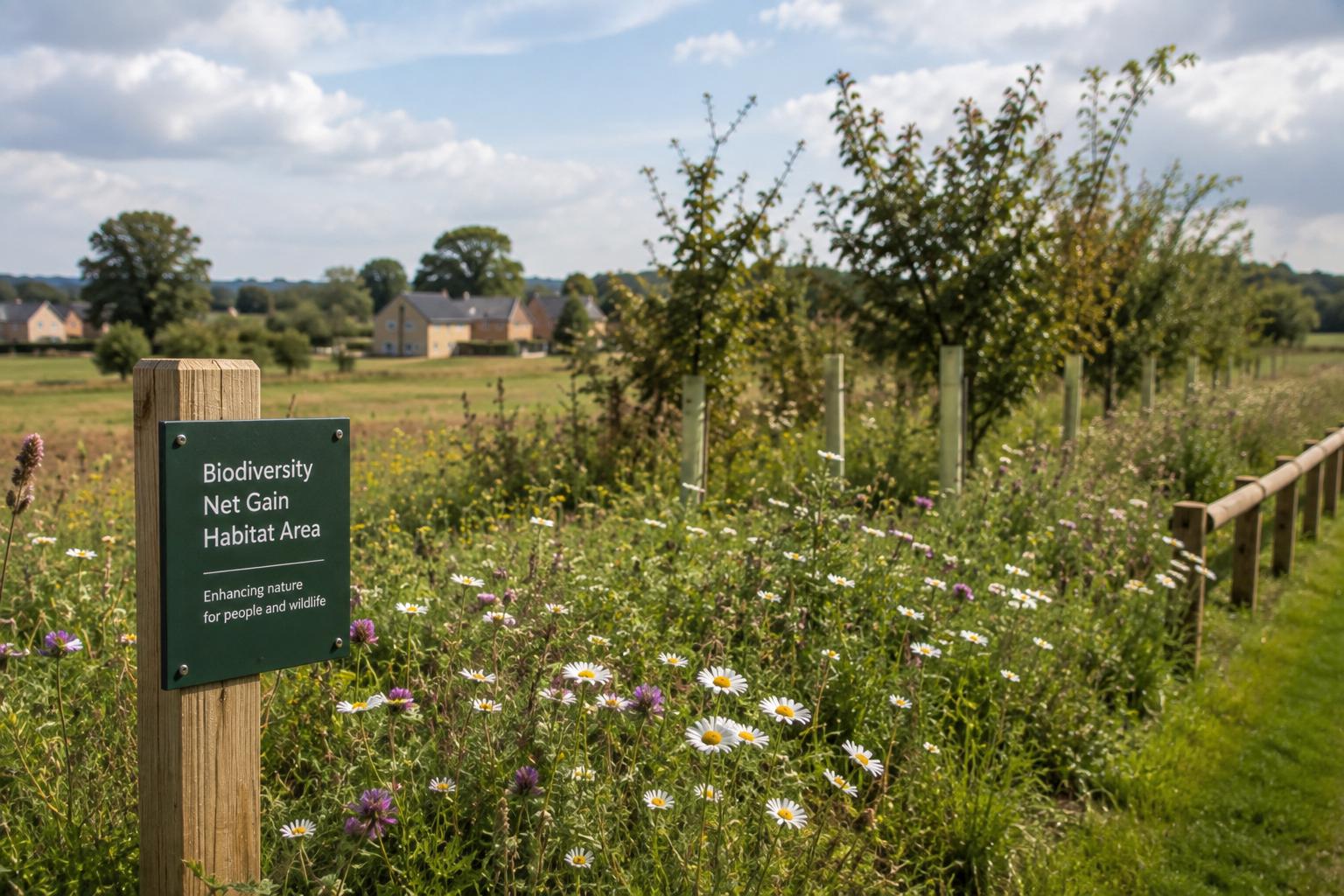
Whether biodiversity gains are delivered on site or off site, the strategy needs to be achievable over the long term.
Significant on-site gains and registered off-site gains used for mandatory BNG must normally be maintained for at least 30 years.
This means a habitat proposal needs to be capable of being established, managed and monitored for the required period – not simply generate the necessary number of units in the metric.
Ecology-led 30-year Habitat Management and Monitoring Plans can help translate BNG commitments into practical habitat establishment, management and monitoring.
For development teams, considering these requirements early can help identify whether a proposed habitat strategy is genuinely deliverable and what its long-term implications may be.
What should development and strategic land teams do now?
Following the 6 August changes, a proportionate approach is to:
- Check the red line area. A development site of 0.2ha or below may qualify for the new area-based exemption.
- Establish whether priority habitat may be affected. Priority habitat can prevent reliance on the area-based and de minimis exemptions.
- Do not confuse a BNG exemption with an ecology exemption. Other ecological considerations and survey requirements may still apply.
- Establish the correct development category. Do not assume that a site described commercially as “small” or “medium” has a particular BNG status.
- Understand the biodiversity baseline before fixing the layout. Where BNG applies, early metric testing can show how habitat retention or design changes affect biodiversity-unit requirements.
- Consider on-site and off-site delivery together where the minor-development rules allow. Compare development capacity, unit requirements, cost and long-term deliverability.
- Build realistic BNG assumptions into viability. The relevant cost is not simply a headline biodiversity-unit price; land requirements, design implications, professional input and long-term habitat delivery can also matter.
Making BNG part of better development decisions
The post-6 August reforms provide greater flexibility for some smaller development sites, but they do not remove the importance of understanding ecology early.
For one 0.2ha development site, the new exemption may mean mandatory BNG does not apply.
For another site of exactly the same size, the presence and impact of priority habitat could produce an entirely different position.
For sites that remain subject to mandatory BNG, understanding the baseline early can help project teams make better-informed decisions about development capacity, layout, viability and on-site versus off-site delivery.
Ecology by Design supports developers, strategic land teams, landowners and professional project teams throughout the BNG process, including early feasibility advice, baseline habitat assessments, statutory biodiversity metric calculations, Biodiversity Gain Plans, on-site and off-site delivery strategies, appraisal of landholdings, biodiversity-unit strategies and ecology-led 30-year Habitat Management and Monitoring Plans.
If you are appraising, promoting or designing a development site following the August BNG changes, speaking to an ecologist early can help establish the biodiversity baseline before key assumptions around land, layout, programme and viability are fixed.
Call Ecology by Design on 01865 893 346 to discuss your site.
BNG for small and medium sites: frequently asked questions
-
What is the 0.2ha BNG exemption?
From 6 August 2026, mandatory BNG does not apply to planning applications in England where the development site's red line boundary is 0.2 hectares or below, unless the development negatively impacts on-site priority habitat.
-
Does BNG apply to a site of exactly 0.2ha?
A development site of exactly 0.2ha can fall within the area-based exemption because the threshold applies to sites of 0.2 hectares or below. The exemption cannot be relied upon where the development negatively impacts on-site priority habitat.
-
Does BNG still apply to minor development?
Yes. Minor development is not automatically exempt from mandatory BNG. Where a development does not qualify for the 0.2ha exemption or another exemption, BNG requirements can still apply.
-
What counts as a medium site for BNG?
“Medium development” is not currently a standalone statutory BNG category with separate mandatory BNG rules. The relevant development category, applicable exemptions and ecological baseline need to be established for the individual proposal.
-
Can minor developments deliver BNG off site?
Yes. From 6 August 2026, qualifying minor developments subject to mandatory BNG can consider on-site and registered off-site gains at the same stage and can choose off-site delivery without considering on-site delivery first. Statutory biodiversity credits remain the last resort.
-
Does a BNG exemption mean ecological surveys are not required?
No. An exemption from statutory BNG does not automatically remove other ecological considerations, planning policy requirements or survey requirements. Protected species, habitats, designated sites and other ecological receptors may still need to be considered depending on the site and proposal.


