Wintering and Migratory Bird Surveys: Why Planning Ahead Pays Dividends for Development

Wintering bird surveys may be needed where a proposed development could affect important populations of birds using a site during the non-breeding season. For renewable energy, infrastructure, strategic land and other development projects, the need for surveys will depend on factors including the habitats present, existing bird records, nearby designated sites and the potential impacts of the scheme.
Planning ahead matters because these surveys are seasonal and, as set out below, the season starts earlier than many project teams expect. Identifying potential survey requirements early gives teams time to collect an appropriate ecological baseline and, where necessary, respond to the findings through scheme design and mitigation.
Not every site requires the same level of survey effort. Reviewing the site's habitats, wider ecological context and existing bird data first can help establish whether surveys are necessary and what a proportionate programme should look like.
What is a wintering bird survey?
A wintering bird survey, sometimes referred to as a non-breeding bird survey, is used to understand the bird species and populations using a site outside the breeding season.
Depending on the project and ecological context, surveys can help establish:
- which bird species are present and in what numbers
- how birds use the habitats within and around the site
- important feeding and roosting areas
- patterns of movement through the wider landscape, and
- whether birds using the site could be associated with nearby designated sites
The appropriate survey methods, area, frequency and duration depend on the site, species and proposed development. For development teams, the purpose is not simply to produce a species list, it is to establish a robust baseline against which the potential effects of a proposed scheme can be assessed.
Why September and October matter
As summer draws to a close, wintering bird surveys may not be the first item on a development programme. But September is precisely the right time to consider whether birds could be an important ecological receptor and whether waiting until winter could leave a gap in the evidence.
For sites likely to support wintering birds, monthly surveys between November and February may provide coverage of the core winter period. However, where a site also has the potential to support passage birds, a wider survey window, potentially extending from September to March may be appropriate.
This distinction matters because autumn migration doesn't fit neatly within a conventional winter survey season. Birds may be arriving in the UK for winter, departing for warmer regions, dispersing after breeding or passing through on longer journeys. BTO BirdTrack data show that species such as redwing, fieldfare, jack snipe and brambling typically begin arriving in parts of the UK during September and October.
For developments that could affect bird movements or introduce a collision hazard (e.g. wind turbines, overhead infrastructure, masts, tall or extensively glazed buildings) the autumn migration period can be particularly relevant. By the time surveys of the settled winter population begin, some species may already have passed through the area.
Not every development needs surveys from September through to March. But where autumn passage is potentially relevant, beginning the assessment in November could already be too late to capture the necessary evidence.
When are wintering bird surveys required for development?
There is no single development type or site size that automatically triggers a survey. Surveys may be appropriate where the habitats present, existing records or relationship with designated sites indicate that a proposed development could affect important wintering or migratory bird populations.
Early ecological review is particularly important where:
- the site is within or close to a Special Protection Area (SPA), Ramsar site or Site of Special Scientific Interest (SSSI) designated for its bird interest
- habitats within the site could be functionally linked to a designated site
- the site contains wetlands, waterbodies, floodplain, estuarine or coastal habitat, open farmland, grassland, brownfield land or other habitat capable of supporting important feeding or roosting birds
- local records identify notable concentrations of waterbirds, waders, geese, swans, raptors or declining farmland birds
- the proposals could cause habitat loss, fragmentation, displacement or disturbance through noise, lighting, construction activity, people or pets
- turbines, wires, glazing or other structures could present a collision risk, or
- an Ecological Impact Assessment (EcIA), Environmental Impact Assessment (EIA) or Habitats Regulations Assessment (HRA) requires a robust understanding of bird use during the relevant seasons
Large areas of agricultural land, grassland, wetlands, waterbodies and coastal habitats can all be relevant, depending on the species and location. Wintering birds are therefore an important consideration for solar and wind projects, but they are not exclusively a renewable energy issue. Strategic land, infrastructure, residential and commercial development, minerals and waste sites and other schemes may also require assessment where the ecological context indicates potential effects.
Where a plan or project could significantly affect the designated features of an SPA or other protected European site, the competent authority must consider those effects through the Habitats Regulations Assessment process.
Start with the baseline habitats
Understanding the habitats present within the development site and surrounding landscape is an important first step.
Different species use different habitats and food resources during the winter months. Agricultural land may provide feeding opportunities for geese, swans, waders and farmland birds, while wetlands and waterbodies can support waterfowl and waders. Grassland, scrub, hedgerows and other habitats may also provide feeding, roosting or refuge opportunities. Land management can influence this too, where cropping patterns and other practices can affect the availability of suitable habitat and food between seasons.
The ecological relevance of a site therefore cannot be determined from its size or broad land use alone. A Preliminary Ecological Appraisal can provide an initial understanding of the habitats present, wider ecological context and potential requirement for specialist surveys.
Existing bird data can help define a proportionate survey programme
Before recommending field surveys, existing ecological information can be reviewed to understand what has previously been recorded within the site and wider landscape. Depending on the project, this desk-based assessment may consider records from the relevant local environmental records centre, statutory and non-statutory designated sites, previous records of wintering bird species and assemblages, records of priority species or species of conservation concern, and other relevant ecological datasets.
These records can then be considered alongside the habitats present and the nature of the proposed development. For example, if suitable feeding or roosting habitat occurs on site and previous data identifies important wintering bird populations nearby, targeted field surveys may be appropriate to establish current site use. In other circumstances, the evidence may support a more focused survey approach. The objective is always survey effort that is proportionate to the ecological sensitivity of the site and the potential impacts of the development.
Designated sites and functionally linked land
Birds are mobile, so ecological assessment may need to look beyond the red line boundary. Special Protection Areas (SPAs), Ramsar sites and some Sites of Special Scientific Interest (SSSIs) support important bird populations or assemblages, and the birds associated with them can use land beyond their boundaries for feeding, roosting and other activities.
Where land outside a protected site plays an important role in supporting its bird populations, it may be considered functionally linked land i.e. habitat outside the designated boundary that is critical or necessary to the ecological or behavioural functions of one or more qualifying features of the protected site. This could include apparently ordinary farmland, grassland, floodplain or waterbodies used by SPA birds at particular times of day, in certain weather conditions, or in response to changes in water levels, cropping or disturbance.
A proposed development does not therefore need to fall within a designated site to have a potential ecological relationship with it. The distance between a site and a designated site is only one consideration; existing bird records, suitable habitats and patterns of activity across the wider landscape all help determine whether that relationship requires further investigation including, where relevant, which species are present, the numbers involved, how regularly they use the site, and how the proposals could affect that use.
How wintering bird surveys are carried out
There is no single survey methodology suitable for every development. Survey design should be proportionate to the nature and scale of the proposals, the habitats present, the likely bird assemblage and the potential impact pathways, and should be designed by a suitably experienced ecologist or ornithologist rather than applying the same programme to every site.
Depending on the site and the questions the assessment needs to answer, the work may include:
- daytime walkover surveys recording species, numbers, distribution and behaviour
- vantage point surveys recording flight activity, including flight height, direction and duration
- targeted surveys of feeding areas, waterbodies or high-tide roosts
- dawn and dusk surveys of movements into or out of roosting areas
- nocturnal surveys, where important species may use the site after dark, for example, where species such as Golden Plover could use farmland at night, and
- species-specific surveys focused on a protected, notable or particularly sensitive receptor
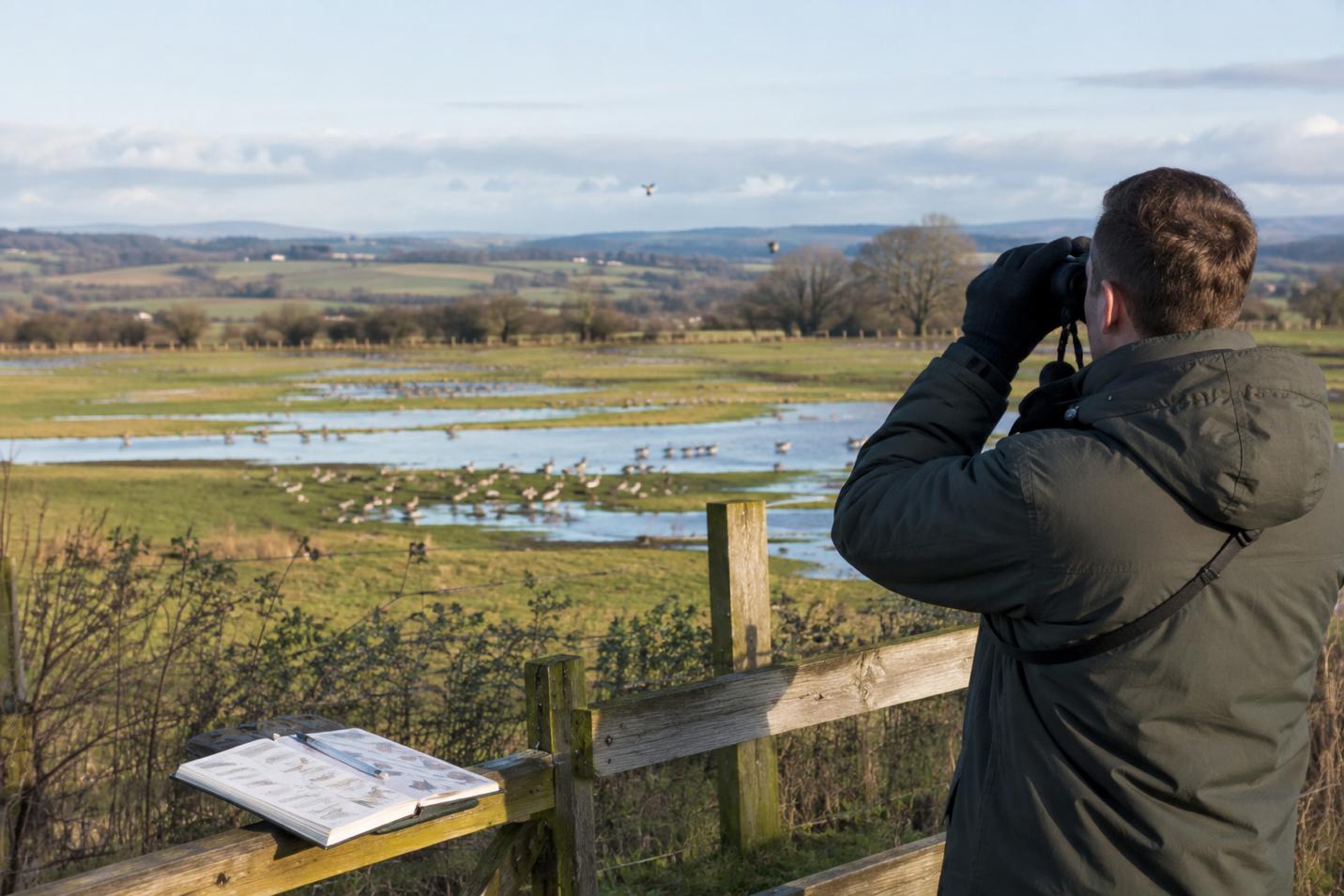
An experienced ornithologist may record the species and numbers present, their locations and distribution, feeding and roosting behaviour, habitat use, movements across or around the site, and flight activity where relevant. The survey area may also need to extend beyond the planning application boundary, particularly where birds move between different feeding and roosting areas, or where construction and operational effects could extend into adjacent habitats.
Vantage point surveys and collision risk modelling
Vantage point surveys are particularly important for wind energy developments, where sufficient information is needed to understand how target species use the airspace around proposed turbines. During these surveys, experienced ornithologists record species and number of birds, flight route and direction, flight duration, flight height or height band, behaviour, and the conditions during the observation period.
These data can then inform collision risk modelling. NatureScot's updated collision risk model requires information on the number of birds flying through or around a site, their flight height, predicted avoidance or attraction behaviour, turbine dimensions and relevant characteristics of the species concerned. The model is a structured tool for estimating potential collision mortality, it does not replace ecological interpretation. Any predicted mortality must still be considered in the context of the sensitivity, conservation status and legal protection of the population concerned, together with potential cumulative effects.
Reflective or transparent glazing and artificial lighting are also increasingly recognised within the UK built-environment sector as factors that may contribute to bird collision risk, with risk depending on a building's design, glazing, lighting, surrounding habitats and relationship with likely bird movement routes.
How survey findings inform scheme design and mitigation
Finding wintering birds does not automatically mean that development cannot proceed. The purpose of the assessment is to understand the potential effects of the proposed scheme and determine whether they can appropriately be avoided, reduced or mitigated.
Potential effects vary between projects but can include:
- Habitat loss: development could remove or alter areas used for feeding, roosting or refuge
- Disturbance: from construction or operational activity, lighting, noise, vehicles or increased human presence
- Displacement: birds avoiding areas they previously used because of changes associated with the development
- Changes to movement: altering how birds move between feeding, roosting and other important areas, and
- Collision risk: particularly relevant for wind farms and, as above, tall or highly glazed buildings
Depending on the findings, the response could include retaining important feeding or roosting areas, adjusting the development footprint or infrastructure locations, maintaining appropriate buffers, protecting important habitat features, considering construction timing, managing lighting or other sources of disturbance, providing or managing alternative habitat, or incorporating mitigation into the wider ecological strategy. Early ornithological input can help identify where infrastructure could interact with important bird activity while there is still scope to consider alternative layouts, reducing the risk of ecological findings requiring more substantial design changes later in the planning process.
When are wintering bird surveys carried out?
Wintering bird surveys are seasonal, so timing needs to be built into the development programme. Natural England's standing advice for onshore wind development identifies November to March as the wintering bird survey period and recommends one or two visits per month for non-breeding birds but, as set out above, this should not be applied as a universal methodology to every development. Migratory species in particular can require consideration outside the core winter period, and missing September and October will not undermine every assessment, but it could leave a significant evidence gap where autumn passage or collision risk is relevant.
Waiting until late winter to commission surveys may also mean that a complete survey programme cannot be undertaken until the following year. From a development perspective, the key point is simple: if wintering or migratory bird data could be needed to support planning, the requirement should be identified before the relevant survey window is lost.
Could two winter seasons of survey data be required?
Potentially, but two seasons should not be treated as a standard requirement. For some sensitive or complex sites, a single winter may not provide sufficient evidence to characterise bird populations and habitat use robustly, for example, where important bird populations are associated with a nearby designated site, bird numbers or distribution vary significantly between years, the proposed development could result in significant effects, or the local planning authority or another stakeholder considers additional evidence necessary. Early engagement with the local planning authority and, where appropriate, Natural England can help establish whether the proposed survey scope and duration are likely to provide an appropriate evidence base.
Wintering bird surveys for solar farms and wind farms
Wintering and migratory bird assessment can be particularly relevant to renewable energy development, because projects may cover substantial areas of land or interact with habitats and movement routes used by birds.
Large solar farms, for example, can encompass agricultural land that may provide feeding or roosting habitat, so assessment may need to consider habitat loss, disturbance or displacement. For wind farms, habitat use and bird movements need to be understood alongside potential collision risk which is where flight activity data, vantage point surveys and collision risk modelling (above) become particularly important.
The presence of wintering or migratory birds does not automatically make a site unsuitable for renewable energy development. What matters is understanding which species are using the site, how and when, the importance of that habitat use, whether important or designated populations are involved, how the proposed development could affect them, and whether potential effects can be avoided, reduced or mitigated.
What should developers do before the winter survey season?
For renewable energy developers and other project teams progressing sites towards planning, a practical approach is to:
- Review the baseline habitats: establish whether the site and surrounding land could provide suitable feeding, roosting or other habitat for wintering or passage birds
- Check designated sites in the wider landscape: consider whether bird populations associated with relevant protected sites could use the development area
- Review existing bird data: previous records and assemblage information can help establish whether field surveys are appropriate and what they should target
- Consider whether autumn passage is relevant: not every site needs a September start, but for sites with collision risk or passage habitat, waiting until November may already be too late
- Define a proportionate survey programme: methods, coverage and effort should reflect the site's sensitivity and the potential effects of the development
- Consider early engagement with the LPA: for sensitive or complex sites, this may help clarify expectations around the evidence required
- Build seasonal requirements into the project programme: establish potential survey needs before the relevant window is underway or has passed, and
- Use the findings to inform the scheme: where potential effects are identified, consider opportunities to avoid or reduce them through design and mitigation
Planning ahead pays dividends
Wintering and migratory bird surveys are most valuable when they form part of early project planning rather than becoming a late requirement before submission. Understanding the baseline habitats, designated-site context, existing bird records and the relevance of autumn passage can help determine whether surveys are needed and what level of work is proportionate. Where field surveys are appropriate, planning ahead provides time to collect the necessary seasonal evidence and consider the findings alongside scheme design.
For renewable energy developers in particular but also for strategic land, infrastructure and other development projects, this can provide greater certainty around ecological requirements, planning evidence and programme.
Ecology by Design supports project teams with ecological desk studies, baseline habitat assessments, wintering, migratory and breeding bird surveys, flight activity and vantage point surveys, collision risk modelling, impact assessment and practical mitigation advice.
If you have a proposed development progressing towards planning and are unsure whether wintering or migratory bird surveys could be required, speak to our team early. We can review the site's ecological context and existing data to help establish a proportionate survey approach and appropriate timescales.
Call Ecology by Design on 01865 893 346 to discuss your project.
Frequently asked questions
-
What is a wintering bird survey?
A wintering bird survey assesses the bird species and populations using a site during the non-breeding season. Depending on the project, it can establish species, numbers, distribution, feeding and roosting activity, habitat use and movement through the wider landscape.
-
Why do September and October matter for bird surveys?
Autumn migration is a distinct period during which winter visitors arrive, summer visitors depart and other species pass through without remaining for winter. Some species, such as redwing, fieldfare, jack snipe and brambling, typically begin arriving from September. Where a development could affect bird movements or pose a collision risk, starting an assessment in November alone may miss this activity.
-
When are wintering bird surveys required for development?
They may be appropriate where suitable habitat, existing bird records, nearby designated sites or the nature of a proposed development indicate potential effects on important wintering or migratory bird populations. Requirements should be determined on a site-specific basis.
-
What months are wintering bird surveys carried out?
Survey timing depends on the site, species and purpose of the assessment. Natural England's standing advice for onshore wind development identifies November to March for wintering birds, but where passage birds are relevant, a wider window from September may be appropriate.
-
How are wintering bird surveys carried out?
Methods can include walking defined survey routes, vantage-point observations, targeted counts, and dawn, dusk or nocturnal surveys where relevant. The appropriate approach depends on the habitats, species of interest, survey area and potential impacts of the proposed development.
-
What is the difference between wintering and breeding bird surveys?
Wintering bird surveys focus on bird activity during the non-breeding season, while breeding bird surveys assess bird populations and activity during the breeding season. Depending on the site and proposed development, one, both or neither may be appropriate.
-
Do solar farms and wind farms need wintering bird surveys?
Not automatically. Requirements depend on the site's habitats, existing records, relationship with designated sites and potential effects of the proposed scheme. For wind farms, flight activity and collision risk are also likely to be relevant. Early ecological assessment can help determine whether surveys are necessary.
-
Why do designated sites matter if they are outside the development site?
Bird populations associated with designated sites may use land outside their boundaries (known as functionally linked land) for feeding, roosting or other activities. Where there is a potential ecological relationship, the development site and wider landscape may therefore need to be considered.
-
Can wintering bird survey findings affect a proposed development?
Yes. Survey findings can identify areas important for feeding, roosting or movement and inform decisions about layout, infrastructure, buffers, construction timing and mitigation. Identifying these issues early generally provides more opportunity to respond through scheme design.
If you are planning a development and want to understand whether autumn or winter bird surveys may be required, contact our team now to avoid missing a key survey window.
Sources
Bird Survey Guidelines — Non-breeding Walkover Survey: https://birdsurveyguidelines.org/non-breeding-walkover-survey/
BTO — Autumn Migration: https://www.bto.org/get-involved/volunteer/projects/birdtrack/bird-recording/by-migration-season/autumn-migration
Defra/Natural England/NRW/Welsh Government — Habitats Regulations Assessments: https://www.gov.uk/guidance/habitats-regulations-assessments-protecting-a-european-site
Natural England (2021) — Identification of Functionally Linked Land Supporting SPA Waterbirds in the North West of England (NECR361): https://publications.naturalengland.org.uk/publication/6303434392469504
NatureScot — Effect of aviation obstruction lighting on birds: https://www.nature.scot/doc/information-note-effect-aviation-obstruction-lighting-birds-wind-turbines-communication-towers-and
RICS (2022) — Tall buildings should not kill birds: https://ww3.rics.org/uk/en/modus/built-environment/commercial-real-estate/tall-buildings-should-not-kill-birds.html
NatureScot — Recommended Bird Survey Methods for Onshore Wind Farms: https://www.nature.scot/doc/recommended-bird-survey-methods-inform-impact-assessment-onshore-windfarms
NatureScot — Updated Collision Risk Model Guidance: https://www.nature.scot/doc/guidance-using-updated-collision-risk-model-assess-bird-collision-risk-onshore-wind-farms
Natural England — Wild bird surveys and monitoring for onshore wind farms: https://www.gov.uk/guidance/wild-birds-surveys-and-monitoring-for-onshore-wind-farms


